ITF Transport Data, Statistics and Modelling Workshop
Code credit: Exercises 1 and 2 were written by Nick Caros. This website is deployed from a fork of his original repository.

This repository accompanies a contribution to the ITF conference on transport data, statistics and modelling in Ukraine (12 June 2026).
Keynote: Building a Community of Transport Statistics and Modelling Practitioners in Ukraine, drawing on experiences with open data, open source tools, and reproducible workflows in transport planning.
Workshop Agenda
- 11:30 – 12:30 Interactive Exercise, Part 1 — emerging transport data sources
- 13:30 – 14:30 Case studies: emerging methods for transport statistics and modelling
- 14:30 – 15:30 Interactive Exercise, Part 2 — urban travel demand modelling
- 16:00 – 17:00 Keynote speeches and open discussion
- 17:00 – 17:30 Recap and closing
Exercises
- Exercise 1: Open Data for Transport Planning — extract, check, manipulate, calculate, and visualise open data for a Ukrainian city.
- Exercise 2: OD Demand & Network Assignment — build an origin-destination demand matrix and assign flows to the road network.
To run the code
There are several options for running the code:
- IPython/Jupyter Notebook: You can run the code in a Jupyter Notebook environment. Install the required libraries (e.g.,
osmnx,worldpoppy,geopandas) and copy the code into a notebook cell to execute it. - GitHub Codespaces: Click the “Open in GitHub Codespaces” button at the top of this page to launch a cloud-based development environment with all dependencies pre-installed. This is the recommended option for ease of use.
- Local Python Environment: If you prefer to run the code locally, ensure you have Python installed along with the necessary libraries. You can use a virtual environment to manage dependencies. Clone the repository and run the code in VSCode (or) another IDE if you have it set up.
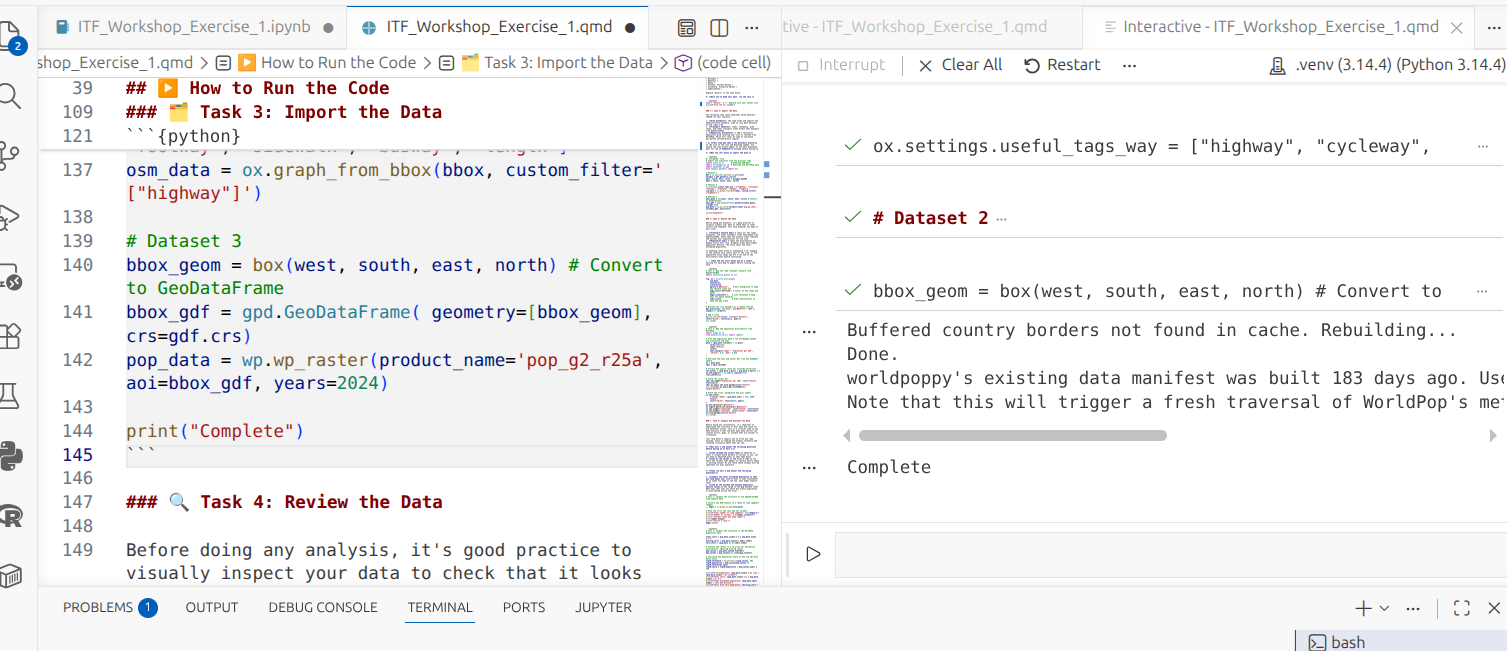
After opening the repo in VSCode you should choose something like the following. You can choose whether to run the code chunks in Jupyter notebooks or Quarto (shown below).
Source
The original workshop repository is at github.com/ncaros/ukraine-workshop.
This Quarto website version is maintained at github.com/Robinlovelace/itfworkshop.
Further reading
For more context and options to run the materials: - Ukrainian Refugee Flows — animated map of refugees from Ukraine by country of asylum (2022–2025), using data from the UNHCR Refugee Statistics API. - Rendered Website — view the fully rendered Quarto website. - GitHub Codespaces — launch a cloud-based development environment (requires a GitHub account) using the fork repository. - Original Repository — explore the original source code developed by Nick Caros.