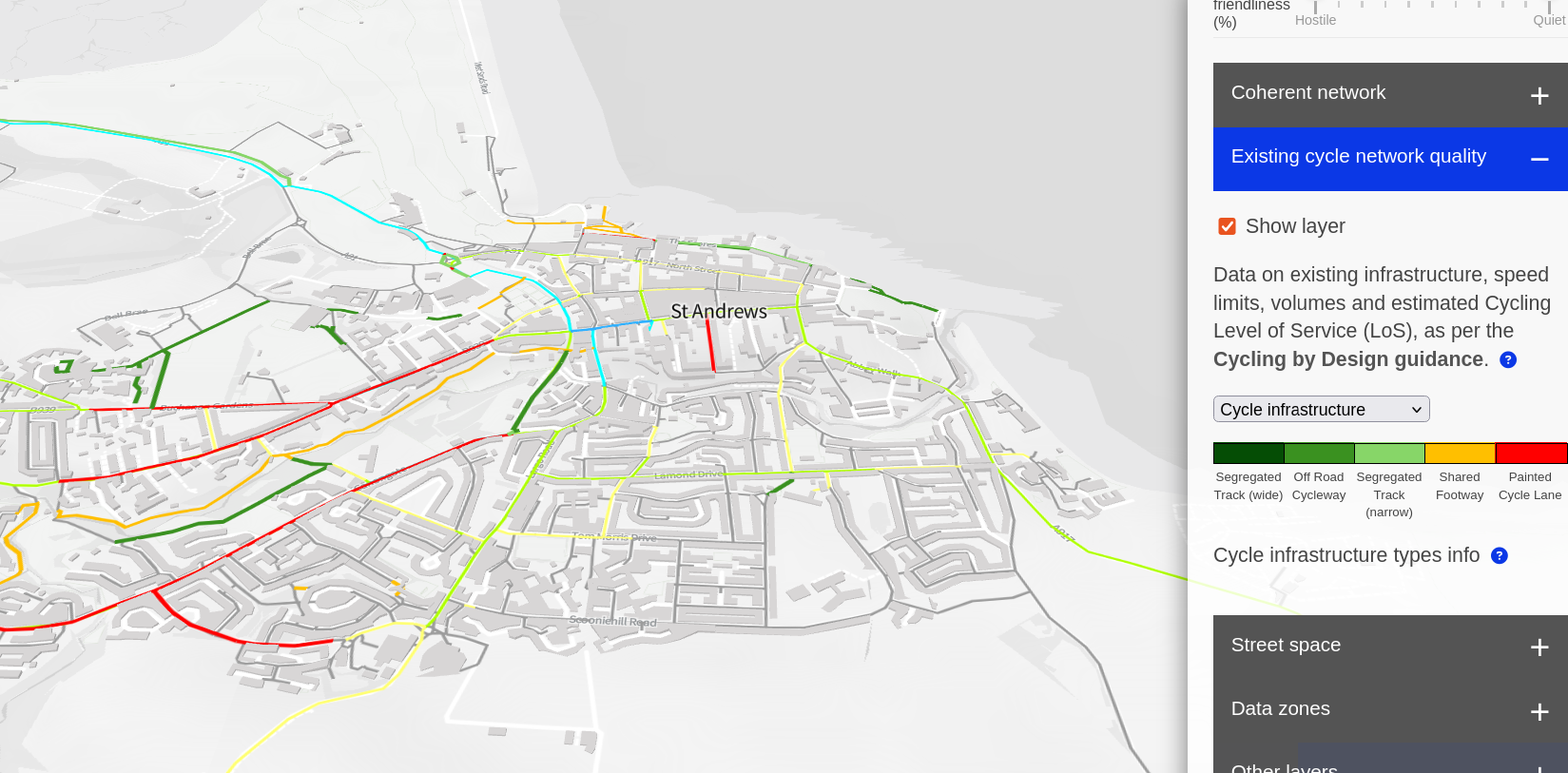
Transport models historically rely on limited input datasets, such as ‘trip generators’ and simplified networks, leading to biases and blind-spots. This lack of data diversity can lead to biases and blind-spots in model outputs. For example, over-reliance on commuting data over-emphasises arterial routes to historic employment centres, while motorised traffic datasets disproportionately highlight long-distance car trips and neglect active travel. Transport models were developed at a time when data was scarce and expensive to collect but the ‘data revolution’ has changed this. We argue that models should be capable of integrating open, proprietary, and crowdsourced, datasets, with ease of integrating new data sources being a key design principle. We present a case study of this approach in the Network Planning Tool for Scotland (NPT), which is publicly available at npt.scot. The NPT integrates data on transport infrastructure from 4 sources: OpenStreetMap, Ordnance Survey (OS) OpenRoads, OS MasterMap Highways, and OS Mastermap Topography, and we are planning to add more, including from the Scottish Spatial Hub, that integrates datasets from Scottish local authorities and partners. Furthermore, the NPT integrates multiple datasets on transport behaviour (including from the Census, the Scottish Household Travel Survey and the British National Travel Survey), and scenarios of change based on international datasets, supporting more data-driven cycling strategies. The results highlight the benefits of data integration, with results tending to improve as more data sources are added, and diminishing returns highlighting the importance of careful selection of input datasets. The approach, based on reproducible code written in open source languages, can be generalised and packaged for benefit of others seeking develop future-proof modelling solutions to transport challenges. We argue that integrating diverse data sources is essential for future-proof transport modelling, enabling adaptation to evolving travel patterns and behaviours.